Tag: Article

  • The American Dream, Available in All Sizes

    The American Dream, Available in All Sizes

    The American Dream promises that anyone can become somebody. Fashion has made a business out of convincing us that all it takes is the right wardrobe. Yet the industry selling us this fantasy remains deeply invested in the hierarchies that determine who gets to live it.

    The American Dream promises us that social mobility is achievable, and more tangibly, available to anyone willing to put in the countless hours required to turn said dream into physical reality. There are very few industries that have displayed this as clearly as the fashion industry has: the clothes we decide to wear grant us the possibility of living within a facade, acting as the person you have yet to become. 

    Nonetheless, among all the criticism of the American Dream, which is becoming increasingly valid, considering the discourse around the fact that the American Dream may never have been real at all, the fashion industry contradicts the idea of said dream the hardest, while being its biggest reinforcer. Fashion sells you the possibility of becoming someone: luxury campaigns do well because they convince you that there is a reality in which you become the person advertised. Yet, simultaneously, the industry reinforces the exact hierarchies that determine if you fit into that mold at all. 

    In post-war America, aspiration was the most prominent human trait. It was seen within the ideal suburban family, women dressed in structured, perfectly tailored shirtwaist dresses, with the men in respectable greys and flannel suits. These clothing choices communicated stability, and moreover, social acceptance. Not only did it signal that you have made it, but also that you belong within a society heavily governed by conformity. 

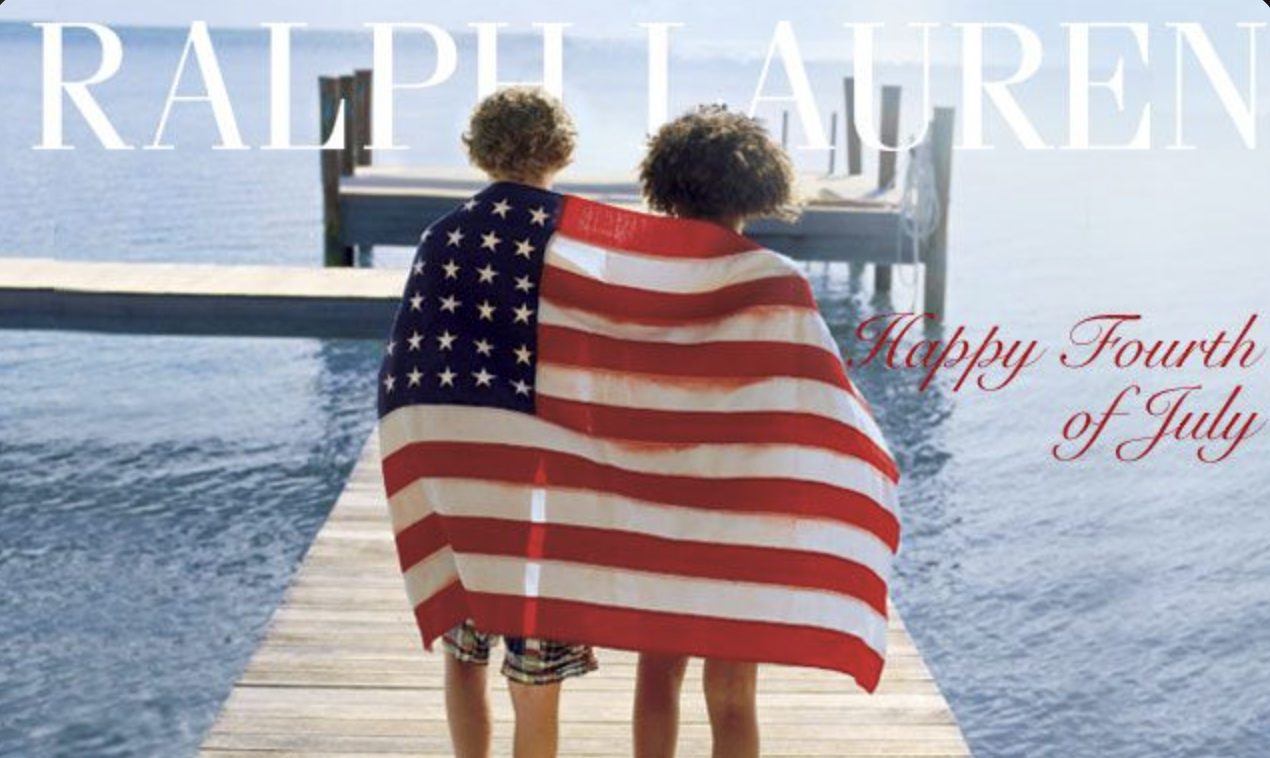
    Of course, as time went on, these codes changed. By the 1980s, designer labels had successfully transformed fashion into a way for people to project success, rather than simply use it as a way to reap your rewards. Herein comes Ralph Lauren, who commercialized the image of aristocratic heritage, and Calvin Klein who took desire and individualism, and repurposed them into a recognisable clothing style. At this point, it would be fair to say that you no longer needed to actually be wealthy, to project the codes of the elite. 

    Nowadays, the American Dream has evolved even further: it has a social media account prevalent on everyone’s feed. Financial anxieties rise, homeownership, and the traditional security that comes with a stable career become increasingly distant hopes and dreams that no longer seem reachable, particularly among younger generations. Thus, this generation has pivoted towards visibility and entrepreneurship as the most prevalent alternate measures of success. 

    Nonetheless, the psychology behind these constantly changing aesthetics remains the same. We as a society crave the safety of belonging and being socially accepted, while also going to considerable measures to establish distinction. We want the group to accept us, while making it inherently clear where our position within it is, and fashion caters to both instincts, allowing you to wear the codes of belonging, and acquire the instruments necessary for differentiation. 

  • HUMILITY DOESN’T SELL

    HUMILITY DOESN’T SELL

    Nobody has ever built an empire from the ground up by convincing others they were merely ordinary. We are taught from childhood that one of life’s biggest virtues is humility. That speaking too highly of yourself is a vice, that you must have confidence but exercise it with extreme restraint. The word vain, often used to describe someone, typically a woman, as unpleasant, is used to condemn someone with an unfortunate character defect. As if an excessive preoccupation with one’s achievements, appearance and importance is somehow morally wrong. Here, I must ask, if not yourself, who else are you meant to be preoccupied with?

    In an industry built on the cultivation of desire, the refinement of image and excessive grandiosity, the supposed shortcomings of the vain start resembling professional qualifications. Fashion has never been interested in rewarding those who make themselves smaller. Take a look at the most influential figures within the industry: they don’t simply produce art, they convince the world that their vision deserves attention in the first place. Identities are cultivated, images curated with precision, and extraordinary control over perception is exercised on the daily, so as society dismisses these traits as vanity and undesirable, the industry turns them into high-yield economic assets.

    The problem, then, is not that we as a society have become too vain, but that we are mistaking self-diminishment for virtue. Humility comes loaded with expectations: remain conscious of your abilities, but not too conscious. Succeed, but don’t make anybody else uncomfortable. Pitch yourself, but don’t be arrogant, conceited or self-absorbed. So naturally, ambition becomes something disguised under carefully rehearsed modesty that, frankly, gets you nowhere.

    Let’s look at whose interests your rehearsed modesty actually serves.

    Firstly, it makes you likable. You may attract friends, people who think you’re kind and nice to be around, nonabrasive, one might say. Nonetheless, this comes with a counter-cost: it makes you easily digestible, and those who are easily digested are easily forgotten in the same breath. The expectation to remain modest comes at the cost of softening your opinions, diminishing your ambitions, and most importantly, accommodating the insecurities of those around you. You become responsible not only for your own success, but for making sure no one feels inferior in its presence. What looks like good-willed consideration can easily slip into self-suppression, in which you comfort others and coddle their fears at the expense of your own visibility.

    In the fashion industry, being visible isn’t a quirky advantage; it is the very thing that gets your foot in the door. Consider the difference between someone established and someone emerging, fighting for recognition. A designer with a multimillion-dollar fashion empire can arrive at any event wearing a plain T-shirt and jeans, speak very modestly about all the extraordinary things they’ve done, and remain, without a shadow of a doubt, the most influential person in the room. Here, the designer’s legacy and reputation have established the value of their presence, and there is nothing left for their appearance to prove.

    For the unknown designer, on the other hand, this exact scenario would look entirely different, as without an established reputation or inherited authority, their work has to speak for them in an industry that is, frankly, oversaturated with talent. In this case, remaining inconspicuous doesn’t mean you’ve walked out of that room more liked; it means you’ve walked out unnoticed and disregarded. It would serve everyone well to remember that understatement is a luxury afforded only by those whose importance is already understood.

    An excessive concern with appearance and perception may be shallow in ordinary social life, no point in arguing that, but the conventional condemnation of vanity in fashion has become increasingly absurd. Within the industry, these are fundamental professional competencies. The director who agonizes over and reshoots the visual identity of a campaign possesses the exact same traits as an Instagram model obsessing over making sure the lighting is perfect: exercising the exact same heightened sensitivity to appearance.

    Fashion does not only require attention to detail, but an unreasonable belief that the details matter at all. Of course, if these traits are applied to art, it’s easily described as creative direction or image-making, yet I’m telling you that the distinction between the two isn’t as clear as most would like to believe. Fashion professionals are products of the images they construct, just like their work is a product of them. Their reputation, personality and public identity become recognizable assets that fuel their creative output, and subsequently their success. In this sense, understanding the power of perception without exercising it over yourself to maximize success in an industry where people are hungry would be a curious contradiction.

    Being polite may secure fleeting moments of approval, but approval does not produce cultural significance. A brand can be as pleasant as a Sunday in May without being particularly convincing, and significance is only generated when one has conviction, and well, you cannot have convictions and remain perfectly agreeable.

    The most compelling creative identities possess a sense of themselves that is so unmistakable, so extraordinary, that they are compelling because they make decisions that exclude as much as they attract. They inspire imitation, provoke disagreement and establish distinction. In an attention economy, these traits are not liabilities but assets.

    Now, this doesn’t mean controversy alone can sustain a business, and arrogance can substitute for talent. It most certainly cannot, and yet a strong creative vision will always require you to be willing to be disliked and ultimately withstand criticism. A vision that crumbles under scrutiny was never a strong one to begin with. These qualities are not easily digestible, and truthfully, they do resemble the self-importance we have been conditioned to distrust, and nevertheless, the mindset of fashion’s most influential creative figures is difficult to separate from a completely unreasonable, sometimes extravagant belief in the significance of one’s own ideas.

    Additionally, I would like it explicitly noted that uncertainty is an expensive thing to project when you’re asking others to invest in a vision they have absolutely no personal connection to. If you don’t believe wholeheartedly in your own vision, as its creator and founder, what makes you think a stranger will? False modesty may be a trait that is socially rewarded in unreasonable ways, but don’t forget it also teaches others to underestimate what you hope they will recognize.

    We are operating within an industry whose heart beats with vanity, depends on distinction and breathes through self-belief, yet we continue to inherit an outdated moral vocabulary that treats exceptionality as something that should be followed with an apology.

    Humility is not inherently a weakness, much like vanity is not an inherent strength. Self-importance without substance ultimately gets exposed, just as an inflated ego ultimately deflates under pressure. However, there is something deeply irrational about demanding that individuals pursuing extraordinary achievements behave as though they are just ordinary.

    Vanity may be a sin in the eyes of society. In fashion, it might just be good business.
  • The Ego in Your Wardrobe

    The Ego in Your Wardrobe

    Humans derive great pleasure through possessions. We like to believe that our tastes and aspirations exist independently of public opinion, that we buy things simply because we appreciate them, work hard for them, and deserve them. We look at our wardrobes and think that they hold expressions of our individuality, rather than function as instruments of social comparison. While there is certainly truth to that, I think we are rather dishonest about how much we enjoy having things that other people do not.

    Fashion is public communication: a visual language that is designed to translate something inherently private into a form of scalable, social power. When we possess something, three distinct desires become activated simultaneously:

    1. The desire to possess
    2. The desire to be admired
    3. The desire to be envied

    Society readily forgives the first two. We are taught that envy is an ugly emotion, something to overcome. Acting on envy is often condemned; it makes you a bad friend, someone others rarely want to be around. And yet, humans spend considerable effort constructing lives, appearances, and identities that other people might envy. We condemn an emotion that exists within others, while quietly taking pleasure in being the object of it—a contradiction that is, while peculiar, incredibly revealing of just how selective our moral judgments become when our own egos benefit.

    This begs the question: what exactly makes being envied so satisfying? I would argue that it actually has very little to do with possession, and everything to do with what another person’s desire tells us about where we stand within a specific social hierarchy. Envy tells us that we possess something that someone else lacks, and it simultaneously introduces an element of superiority, placing us above the other person. In this sense, our satisfaction no longer comes solely from what we have, but from the vertical distance between us and those who don’t have it. For a species that is incredibly preoccupied with social comparison and hierarchy—an instinct that has been ingrained in us since the beginning of human nature as a form of survival—that exact distance is intoxicating.

    Interestingly enough, the desire to provoke envy is rarely something that we consciously identify with. Few people would openly sit and tell you that they enjoy making others feel inferior, and perhaps they are, in part, being honest, as I doubt most people enjoy overtly making someone feel less than. However, a lot of the time, envy is provoked subtly through perfectly socially acceptable explanations: good taste, ambition, the fruits of labor, etc. In that sense, other people wanting what we have is simply an unexpected consequence.

    Nevertheless, I ask you to consider what provoking envy—and the desire derived from it—reveals about you. It is, inherently, a psychological shortcut to significance.

    Being envied promises something instantaneous; it tricks you into mistaking awe or silent resentment for genuine respect and value. When in truth, forcing someone to look upward merely delivers a temporary, fleeting reprieve to your own fragile ego.

    Before you go and say, “I definitely don’t do that,” examine your own desires. How many of them exist because others can witness you possessing them? When you construct an outfit or buy a new pair of shoes, how much of it is influenced by the fact that other people will witness it? Even the desire to be “niche,” which is incredibly common within creative fields, is often another manifestation of the desire to feel superior through distinction. Knowing a designer nobody else knows or having a hobby others aren’t aware is possible creates the same sense of possessing something somebody else lacks. Like envy, it creates distinction, and ironically, the desire to be niche is paradoxically dependent on other people’s recognition. You want to be different from everyone else, but everyone must also recognize the difference. Otherwise, what social value does your exclusivity even hold?

    I would say that it is precisely here where the greatest irony lies. In the human pursuit of distinction, we simultaneously become dependent on the recognition of the very people we wish to distinguish ourselves from. Your superiority will never belong to you if it relies on another person’s perceived inferiority. After all, the satisfaction derived from being envied is entirely conditional. It requires an audience and someone insecure enough to acknowledge that you possess something they lack and have it alter their behavior. Remove that audience, and your superiority vanishes along with it.

    Furthermore, there is another consequence that comes along with this pursuit. Envy is a rather dangerous emotion to provoke. To be the object of someone’s envy means to ultimately become the object of someone’s resentment, and the same person admiring your position could derive great satisfaction from watching you lose it. In that sense, it would serve us well to remember that jealousy is a green-eyed monster in both directions: those who experience it are consumed by what they lack, while those who seek to provoke it paint an unnecessary target on their own backs.

    The Swiss psychiatrist Carl Jung introduced us to the concept of the shadow. The shadow applies to aspects of ourselves that we repress, reject, and refuse to acknowledge. We all have a preferred image of ourselves, and oftentimes, our shadow traits contradict our own self-belief. According to Jung, refusing to acknowledge these characteristics does not make them disappear, and the less conscious we are of our own motivations, the more likely we are to have them govern us. In order to truly live life according to our own terms, we must recognize and integrate even the parts of ourselves we don’t particularly like.

    The fashion industry has made an extraordinary business out of the human desire for distinction. It doesn’t simply sell us clothes, but the possibility of being someone worth looking at. The industry is kept alive through fantasy, and luxury fashion houses have long understood that the value of an object in a superficial society is rarely craftsmanship, but what it communicates about the person wearing it.

    I’m the last person to tell you that there is something wrong with wanting beautiful things, but I think we all ought to ask ourselves not whether we enjoy being envied, but whether our desires hold any weight if no one envies us for what we have. After all, what is the point of possessing everything you want if your satisfaction depends on somebody else wanting it too?

  • DEFIANCE ARTICLE

    DEFIANCE ARTICLE

    What does it mean to have authority? Does it mean that you’re unyielding, that you can command a situation to bend to your will, or have we simply mistaken the rewards of conformity as proof of agency and strength?

    Historically speaking, fashion has long been the primary medium through which we communicate power. Authority is branded into buttons, cuffs and tailoring: from the grandiose garments worn by monarchs reigning over poverty-stricken lands to military uniforms that function as badges to which the general population must submit. Long before designer monograms and contemporary status symbols entered the fashion scene, clothing made hierarchy visible, transforming the human body into a tangible translation of institutional dominance.

    However, I ask you to realize that the very garments that traditionally communicate power, by distinguishing their wearers through status and recognition, also demanded the submission of the wearers’ independence, making them slaves to the institution.

    The military jacket speaks to this contradiction within its own seams. Every element of the jacket is constructed to present the wearer as the ultimate symbol of authority. The broad shoulders, tailored torso and high collar form an external skeleton around the human body, turning something that is inherently fluid into something that is constrained and controlled.

    Yet, the same structure that grants you an imposing silhouette, making you seemingly uncontrollable, traps you within its confines. The body is made to live in a form that is predetermined, characterizing the jacket as more than just a uniform, but a role that makes promises it cannot keep. In this aspect, submitting to the appearance of power is to obey the structure that is giving it to you.

    To call yourself truly free, you must question the conditions under which you are operating. After all, how free can you truly be if your freedom is something that another can give or take at will? There is no value in being unyielding and holding command if your own authority operates under conditions that are beyond your control. The human world functions within established hierarchies: climbing the corporate ladder, making your way through a system that gives you the illusion that you’re moving towards the top of the food chain. We have become so encapsulated by seeking authority and power within existing hierarchies that we don’t naturally gravitate towards defiance. In this sense, you should consider that seeking power and approval within established systems is the very act that gives another dominion over you.

    Therein lies the distinction between authority and liberation: authority revolves around the power we are able to exercise within an established hierarchy, whereas freedom concerns our ability to challenge the hierarchy itself.

    In this sense, defiance means recognizing that the rules governing our existence are not the limits imposed on our capability. It means refusing to confuse permission with possibility.

    However, defiance is not an act without consequences: challenging authority means risking security, status and reassurance. To defy, one must willingly exist in a world that offers little security, pursue convictions that are not inherently recognized, and go down a path where success is not guaranteed.

    We have been conditioned to believe that freedom is something that waits for us at the end of a climb, a privilege granted to us through hard work, and yet that privilege remains part of the same structure we have spent our lives climbing. You can stand above everyone else, with the ability to influence, shape and command, while still operating under the same constraints that put you there.

    The fashion industry, with all its contradictions, allows us to examine this ideology with extraordinary precision: to defy is not to reject authority to satisfy some rebellious nature, but to recognize that no institution, however powerful and imposing, possesses a claim over who you are. You are one in eight billion. There is no second iteration of your existence, and no institution, system or hierarchy on this planet possesses the ability to reproduce the exact combination of convictions, contradictions and experiences that create individuality.

    The most fundamental act of defiance is to recognize that the symbols, hierarchies and expectations through which we interpret the world are neither laws nor unshakable. They are conventions, and conventions can be broken. To be truly free is not to reach a position where no one can command you, but to possess the ability to question and subsequently go against the people who assume they can.

    The greatest authority you will ever possess is the authority that determines who you are.

  • The most effective form of control feels like freedom.

    The most effective form of control feels like freedom.

    Passion. Dedication. Ambition.

    When we hear these words, we think of virtue, evidence of soul, and the preexisting character traits of anyone trying to build a life worth living. Sounds noble enough, doesn’t it? A life of pursuit, a life where one is endlessly fulfilled by the reaped rewards of a creative soul recognized.

    There is something profoundly contradictory about a multibillion-dollar industry that claims to celebrate individual freedom, actively demanding the systemic surrender of it from those seeking to participate, converting identity into an unpaid operational subsidy.

    Society is conditioned to believe exploitation looks like obvious coercion: locked factory doors, Amazon sweatshops, and the extraction of labor from workers who have nothing to give and everything to lose. However, we often fail to consider that industries, such as the fashion industry, often manufacture an image that is so glamorous, so aesthetically hypnotic, that they don’t need to trap you in the meat grinder: you’ll willingly jump in yourself, and with enthusiasm.

    This arrangement becomes particularly sinister when one realizes that it does not necessarily require the individual to recognize their own subordination or see themselves as a victim of exploitation. Participation becomes a stamp of exceptionalism, an affirmation proving that you’re able to endure conditions others cannot, and therefore possess some form of superiority and advantage. Through this lens, the very sacrifices that erode your autonomy are reframed as evidence of ambition, resilience, and an entitlement to eventual success.

    The fashion industry has a remarkably sophisticated achievement under its belt: the conversion of subordination into a source of personal pride. As members of an incredibly competitive industry, we stop merely tolerating the conditions that exploit us and begin to defend them, transforming what was initially an exercise of power into an internalized measure of worth. Sociologist Rosalind Gill terms this phenomenon passionate work. Through her framework, applied to creative industries, one understands that when a job is treated as a “calling,” reality becomes increasingly hard to recognize. Thus, we are encouraged to interpret extreme sacrifice not as something demanded, but as something willingly offered in service of our aspirations.

    Herein lies a rather disturbing question: if we believe ourselves to be acting freely, at what point does our willingness to participate cease to constitute genuine autonomy?

    The most effective and durable forms of exploitation aren’t those where one is backed into a corner, but those disguised as self-actualization, where resisting feels like forfeiting one’s dreams. The industry runs on symbolic arbitrage: printing currency that is neither tangible nor necessary for survival: door access, invitations, and titles. In this sense, institutions trade something that costs them nothing to produce for tangible, high-cost human resources, making you trade for it with your health, safety, boundaries, and creative intellectual property.

    This then asks us to consider the sunk cost fallacy and the fusion of our identities, as the more we trade treasured aspects of ourselves for a system, the harder it becomes for us to recognize that the system itself is exploitative. Humans are inherently ego-driven; we possess pride and attachment to our efforts, and admitting exploitation puts one in a position of weakness and requires us to recognize that our efforts were, in some sense, wasted. Thus, we repackage exploitation as necessary discipline.

    In the world as we know it, creative industries are expected to lean extremely progressive. We preach human dignity and equity, viscerally condemning corporate greed, recognizing that an institution underpaying and exploiting workers is a reality so overtly morally ugly that it demands immediate intervention, public outrage, and boycotts.

    Yet, I ask you to consider this: we routinely subject ourselves to the very conditions and dynamics we publicly protest. While macro-exploitation is driven by greed, creatives entering the industry are driven by hunger. This sounds fundamentally different, but our hunger for this particular industry is rarely motivated by material security—God knows fashion doesn’t pay enough for that, but by a sense of existential starvation for recognition. Because this hunger feels like passion, we willingly pay to fuel it with sub-living wages and the subjugation of our bodies, effectively laundering the industry’s exploitation through our own desperate ambition. From this perspective, we too are greedy.

    One could argue that this is fundamentally different, that we are choosing this specific career, that no one forced us to make this choice, which, ironically, is exactly how major institutions view the matter. But if we are conditioned to see the choice as proof that we are following our passions, a fundamentally human instinct, how much choice do we really have in the matter?

  • THE TEMPORARY SELF

    THE TEMPORARY SELF

    Getting dressed in the morning is rarely as simple as the mundane ritual of everyday life suggests. We pick a top, a pair of bottoms, and for those of us with a sense of coordination, maybe shoes that match. Every item we pick somehow says something fundamental, regardless of how simplistic the choice may seem. Even the people who deliberately distance themselves from the so-called “shallow” and “superficial” fashion industry are intentionally making a clothing choice that exudes a part of their identity. In a way, everything we put on our body represents something borrowed: borrowed confidence, borrowed indifference, borrowed composure. At the end of it, you could have an entirely constructed identity that represents the person you want to be perceived as, effectively creating a temporary self. We may dress for a position we have not earned, confidence we do not feel, or a life that has not yet come into fruition.

    Consider this: a young woman secures an invitation to a fashion week event. She knows perfectly well that she is merely a student with a borrowed invitation and not a clue where to stand, but the clothes she picked out earlier that day have made a completely different introduction on her behalf. She is offered a conversation, a certain amount of respect and recognition that she would not have received in yesterday’s clothes. The woman is imprinting on a stranger who is responding to a persona she deliberately crafted to warrant that reaction, and suddenly, they go hand in hand to make that impression feel truthful for both parties.

    You may consider this dishonest and deceiving, and in some ways, you aren’t entirely wrong. Frankly, the woman is putting on a show; her clothes offer evidence of a claim she has not yet proven. However, it is precisely those mundane clothing decisions that may eventually convert her performance into fact. They may not give her a job, a title, knowledge, or relationships, but they give her something much more malleable: opportunity. And suddenly, you have an opening that you can utilize.

    The fashion industry understands perception better than any industry in the world. It is the only sector in the world where perception and chance coincide with something as simple as deciding what to put on your body just hours prior. A particular garment can suggest money and status you do not have, speaking of an obscure designer can suggest knowledge and experience that you don’t embody, and acting as though you don’t particularly care what you’re wearing can suggest privilege, as if you’ve somehow transcended the human need to impress.

    There is also something rather uncomfortable hiding behind this. The fashion industry impacts not only those seeking entrance into the gilded, glamorous world of fashion, but also those pursuing greatness and success in seemingly entirely unrelated sectors. Picture two people seeking the same job in accounting. One applicant has considerable knowledge in the business but has fallen on hard times. Their clothes show wear, and their situation has left them with little money to replace them. The other applicant knows far less about the business but is dressed exactly like the person the employer expects to hire. Who has to spend the first ten minutes of their interview proving that they belong, and who can use those ten minutes to display and showcase real skills? The interview has barely started, and one person already faces the considerable task of overcoming the impression that they are not competent.

    This phenomenon isn’t exclusive to a competitive position and extends to greater revelations surrounding human nature. The World Bank assessed 190 global economies and found that women have, on average, only 64% of the legal protections afforded to men, and they occupy only 3 out of 10 management positions. Black and/or African American applicants receive 32% fewer positive callbacks than corresponding majority groups. This then forces us to consider how the people occupying less financially lucrative positions have less financial ability to construct the “temporary self” necessary to increase their chances of beating someone who may be less qualified.

    That is how an impression can create a material advantage: we look at a stranger, construct an unverifiable history for them, and behave as though our perception is fact, effectively helping them materialize our perception into reality, whether good or bad. We offer one person more attention, greater opportunity, and behave as though it is entirely warranted based solely on how they dress. Later, when that person utilizes that opportunity to construct considerable success, our initial judgement is proven accurate.

    Through this lens, perhaps it is reasonable to consider the construction of the temporary self not only as an endeavor pursued to impress the average person we encounter, but as a way to rewrite society’s preconceived notions about us. It is not merely about changing the person we become when we put on the clothes, but about forcing the person perceiving us to become willing to see beyond their judgement.

    This should make us far less certain of our own eyes. When someone looks as though they belong, are we reacting to demonstrated ability or the image of ability, and which one truly matters in the end?