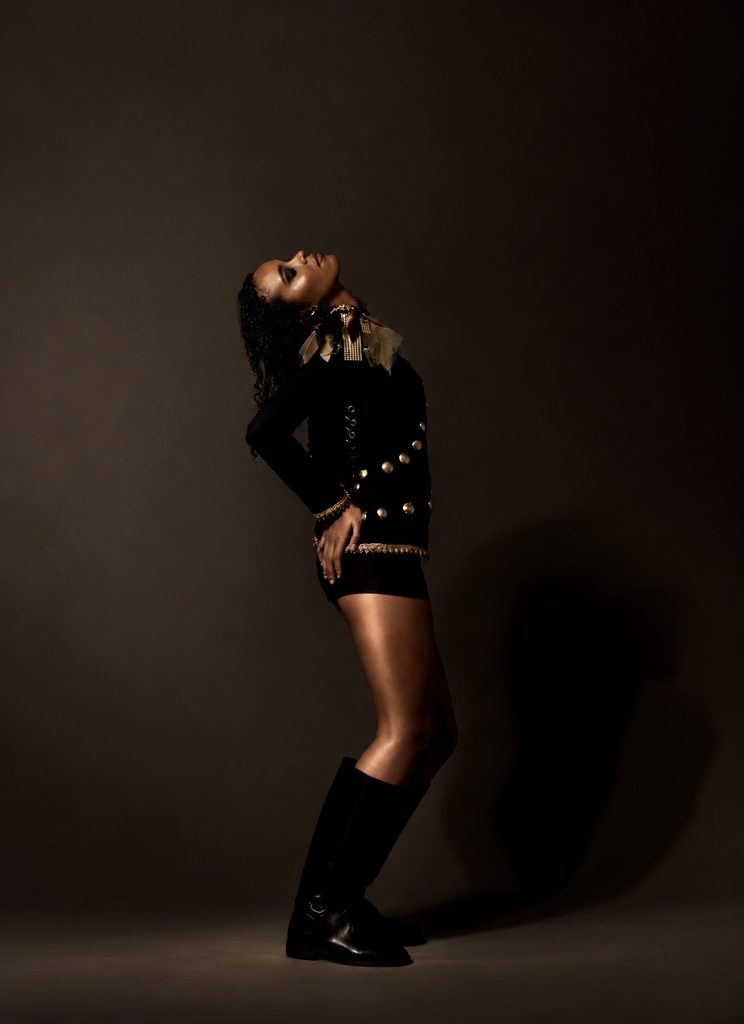
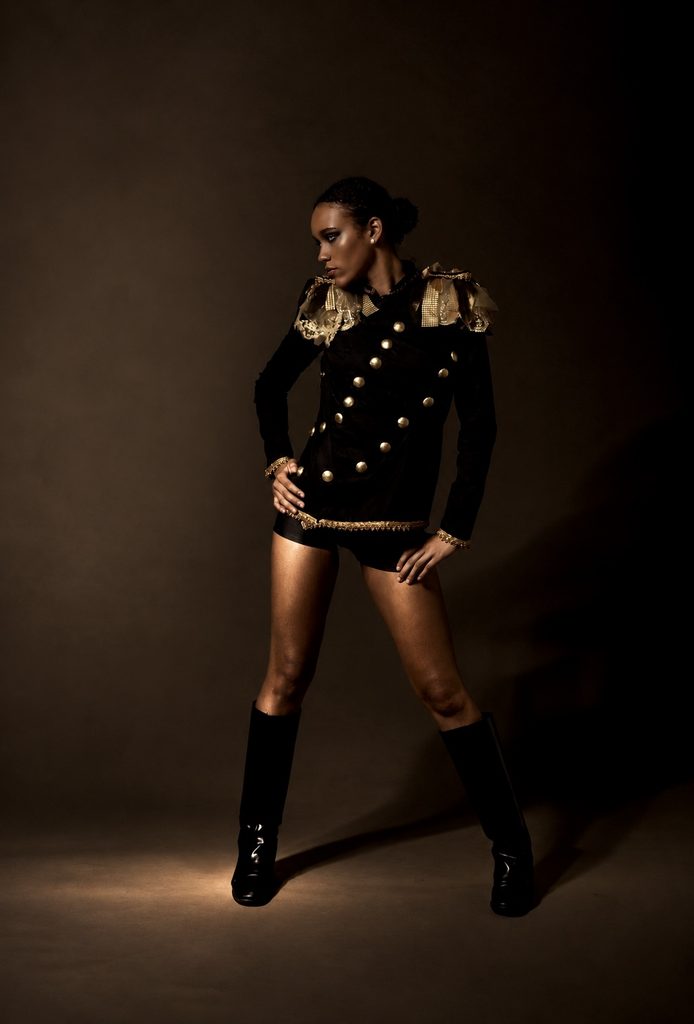
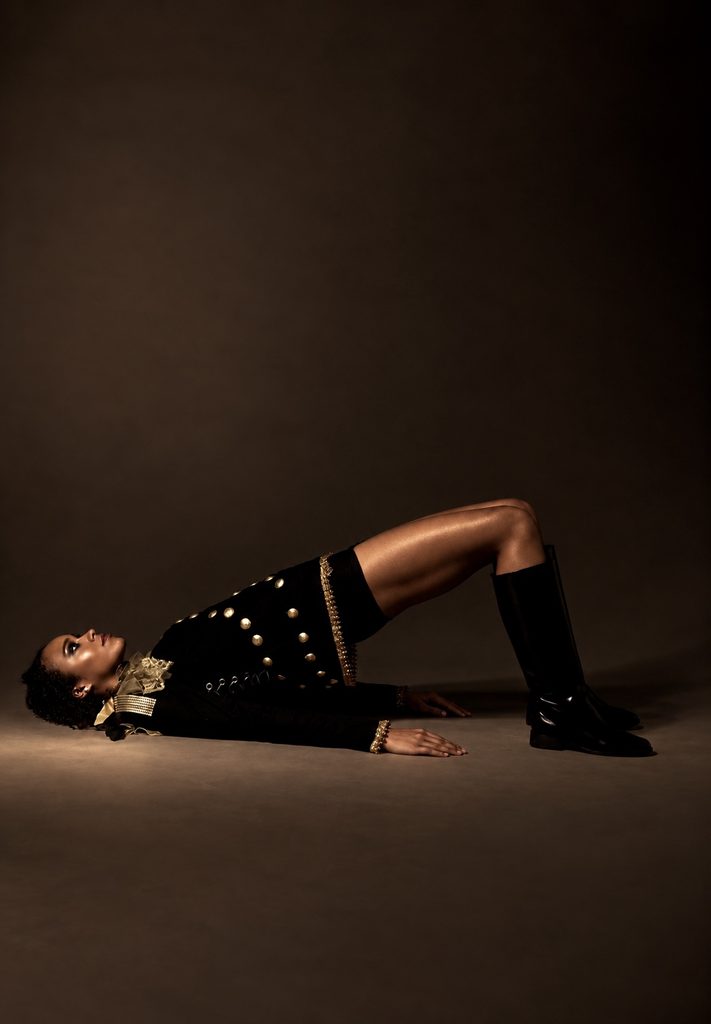
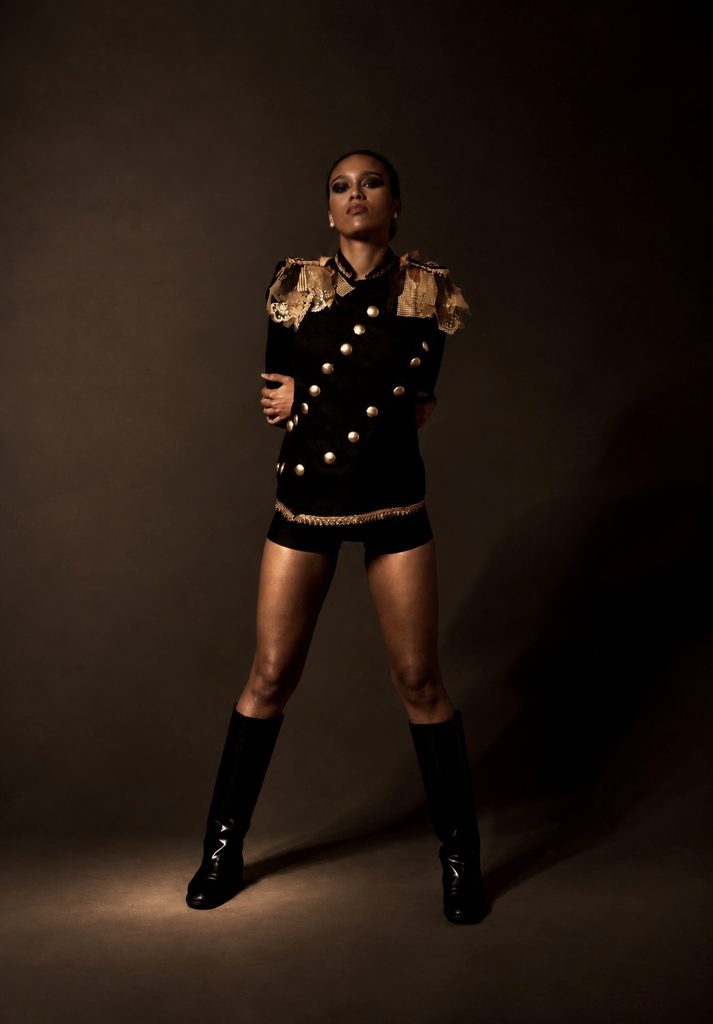
Creative Direction & Styling: Mercedes Famira Parcsetich | Photography: Myra Aashi Jones | Model: Sofia Giovanna Germain | Custom Garment: Isabella Nouriel | For FAMIRA LONDON, 2026.
Creative Direction & Styling: Mercedes Famira Parcsetich | Photography: Myra Aashi Jones | Model: Sofia Giovanna Germain | Custom Garment: Isabella Nouriel | For FAMIRA LONDON, 2026.
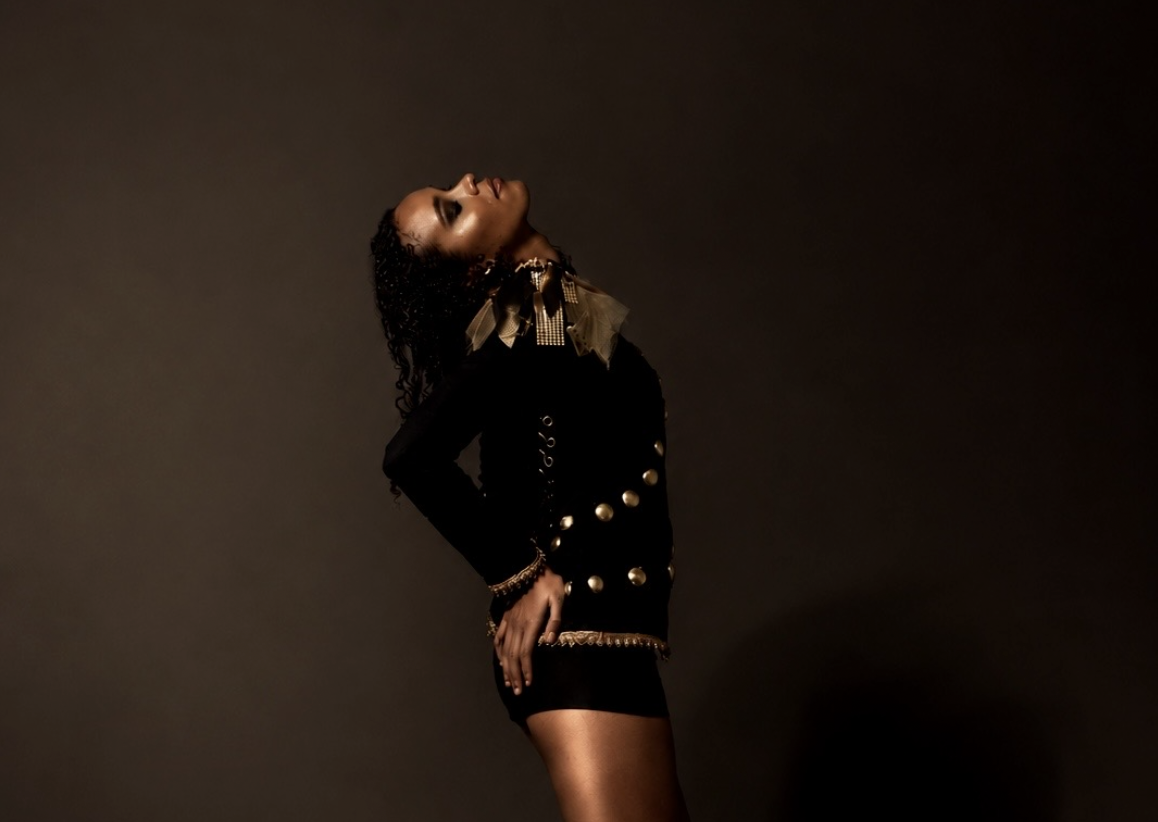
What does it mean to have authority? Does it mean that you’re unyielding, that you can command a situation to bend to your will, or have we simply mistaken the rewards of conformity as proof of agency and strength?
Historically speaking, fashion has long been the primary medium through which we communicate power. Authority is branded into buttons, cuffs and tailoring: from the grandiose garments worn by monarchs reigning over poverty-stricken lands to military uniforms that function as badges to which the general population must submit. Long before designer monograms and contemporary status symbols entered the fashion scene, clothing made hierarchy visible, transforming the human body into a tangible translation of institutional dominance.
However, I ask you to realize that the very garments that traditionally communicate power, by distinguishing their wearers through status and recognition, also demanded the submission of the wearers’ independence, making them slaves to the institution.
The military jacket speaks to this contradiction within its own seams. Every element of the jacket is constructed to present the wearer as the ultimate symbol of authority. The broad shoulders, tailored torso and high collar form an external skeleton around the human body, turning something that is inherently fluid into something that is constrained and controlled.
Yet, the same structure that grants you an imposing silhouette, making you seemingly uncontrollable, traps you within its confines. The body is made to live in a form that is predetermined, characterizing the jacket as more than just a uniform, but a role that makes promises it cannot keep. In this aspect, submitting to the appearance of power is to obey the structure that is giving it to you.
To call yourself truly free, you must question the conditions under which you are operating. After all, how free can you truly be if your freedom is something that another can give or take at will? There is no value in being unyielding and holding command if your own authority operates under conditions that are beyond your control. The human world functions within established hierarchies: climbing the corporate ladder, making your way through a system that gives you the illusion that you’re moving towards the top of the food chain. We have become so encapsulated by seeking authority and power within existing hierarchies that we don’t naturally gravitate towards defiance. In this sense, you should consider that seeking power and approval within established systems is the very act that gives another dominion over you.
Therein lies the distinction between authority and liberation: authority revolves around the power we are able to exercise within an established hierarchy, whereas freedom concerns our ability to challenge the hierarchy itself.
In this sense, defiance means recognizing that the rules governing our existence are not the limits imposed on our capability. It means refusing to confuse permission with possibility.
However, defiance is not an act without consequences: challenging authority means risking security, status and reassurance. To defy, one must willingly exist in a world that offers little security, pursue convictions that are not inherently recognized, and go down a path where success is not guaranteed.
We have been conditioned to believe that freedom is something that waits for us at the end of a climb, a privilege granted to us through hard work, and yet that privilege remains part of the same structure we have spent our lives climbing. You can stand above everyone else, with the ability to influence, shape and command, while still operating under the same constraints that put you there.
The fashion industry, with all its contradictions, allows us to examine this ideology with extraordinary precision: to defy is not to reject authority to satisfy some rebellious nature, but to recognize that no institution, however powerful and imposing, possesses a claim over who you are. You are one in eight billion. There is no second iteration of your existence, and no institution, system or hierarchy on this planet possesses the ability to reproduce the exact combination of convictions, contradictions and experiences that create individuality.
The most fundamental act of defiance is to recognize that the symbols, hierarchies and expectations through which we interpret the world are neither laws nor unshakable. They are conventions, and conventions can be broken. To be truly free is not to reach a position where no one can command you, but to possess the ability to question and subsequently go against the people who assume they can.
The greatest authority you will ever possess is the authority that determines who you are.
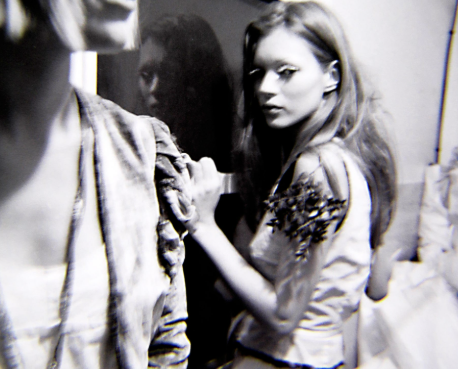
Passion. Dedication. Ambition.
When we hear these words, we think of virtue, evidence of soul, and the preexisting character traits of anyone trying to build a life worth living. Sounds noble enough, doesn’t it? A life of pursuit, a life where one is endlessly fulfilled by the reaped rewards of a creative soul recognized.
There is something profoundly contradictory about a multibillion-dollar industry that claims to celebrate individual freedom, actively demanding the systemic surrender of it from those seeking to participate, converting identity into an unpaid operational subsidy.
Society is conditioned to believe exploitation looks like obvious coercion: locked factory doors, Amazon sweatshops, and the extraction of labor from workers who have nothing to give and everything to lose. However, we often fail to consider that industries, such as the fashion industry, often manufacture an image that is so glamorous, so aesthetically hypnotic, that they don’t need to trap you in the meat grinder: you’ll willingly jump in yourself, and with enthusiasm.
This arrangement becomes particularly sinister when one realizes that it does not necessarily require the individual to recognize their own subordination or see themselves as a victim of exploitation. Participation becomes a stamp of exceptionalism, an affirmation proving that you’re able to endure conditions others cannot, and therefore possess some form of superiority and advantage. Through this lens, the very sacrifices that erode your autonomy are reframed as evidence of ambition, resilience, and an entitlement to eventual success.
The fashion industry has a remarkably sophisticated achievement under its belt: the conversion of subordination into a source of personal pride. As members of an incredibly competitive industry, we stop merely tolerating the conditions that exploit us and begin to defend them, transforming what was initially an exercise of power into an internalized measure of worth. Sociologist Rosalind Gill terms this phenomenon passionate work. Through her framework, applied to creative industries, one understands that when a job is treated as a “calling,” reality becomes increasingly hard to recognize. Thus, we are encouraged to interpret extreme sacrifice not as something demanded, but as something willingly offered in service of our aspirations.
Herein lies a rather disturbing question: if we believe ourselves to be acting freely, at what point does our willingness to participate cease to constitute genuine autonomy?
The most effective and durable forms of exploitation aren’t those where one is backed into a corner, but those disguised as self-actualization, where resisting feels like forfeiting one’s dreams. The industry runs on symbolic arbitrage: printing currency that is neither tangible nor necessary for survival: door access, invitations, and titles. In this sense, institutions trade something that costs them nothing to produce for tangible, high-cost human resources, making you trade for it with your health, safety, boundaries, and creative intellectual property.
This then asks us to consider the sunk cost fallacy and the fusion of our identities, as the more we trade treasured aspects of ourselves for a system, the harder it becomes for us to recognize that the system itself is exploitative. Humans are inherently ego-driven; we possess pride and attachment to our efforts, and admitting exploitation puts one in a position of weakness and requires us to recognize that our efforts were, in some sense, wasted. Thus, we repackage exploitation as necessary discipline.
In the world as we know it, creative industries are expected to lean extremely progressive. We preach human dignity and equity, viscerally condemning corporate greed, recognizing that an institution underpaying and exploiting workers is a reality so overtly morally ugly that it demands immediate intervention, public outrage, and boycotts.
Yet, I ask you to consider this: we routinely subject ourselves to the very conditions and dynamics we publicly protest. While macro-exploitation is driven by greed, creatives entering the industry are driven by hunger. This sounds fundamentally different, but our hunger for this particular industry is rarely motivated by material security—God knows fashion doesn’t pay enough for that, but by a sense of existential starvation for recognition. Because this hunger feels like passion, we willingly pay to fuel it with sub-living wages and the subjugation of our bodies, effectively laundering the industry’s exploitation through our own desperate ambition. From this perspective, we too are greedy.
One could argue that this is fundamentally different, that we are choosing this specific career, that no one forced us to make this choice, which, ironically, is exactly how major institutions view the matter. But if we are conditioned to see the choice as proof that we are following our passions, a fundamentally human instinct, how much choice do we really have in the matter?